


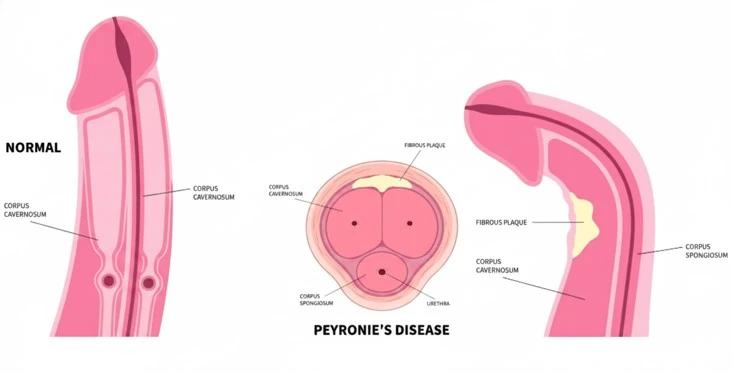
Peyronie’s disease is a condition in which scar tissue, called a plaque, develops inside the penis. This can cause the penis to bend or curve during an erection and may lead to pain, shortening, indentations, or difficulty having sexual intercourse.
Peyronie’s disease can often be treated, but there is no single guaranteed cure for everyone. The best treatment depends on how severe the curvature is, whether the condition is still changing, and whether erectile function is affected. Some men need only monitoring, while others benefit from traction therapy, injections.
1. Best treatment options for Peyronie’s disease
A medically designed traction device gently stretches the penis according to a prescribed protocol. It may help reduce curvature and preserve or improve penile length in some men.
Best suited to: selected patients seeking a non-surgical option. Consistent use and correct fitting are important.
Depending on the country, availability, and clinical suitability, a urologist may consider collagenase injections or other intralesional treatments such as verapamil or interferon. Collagenase can reduce curvature in appropriately selected patients, but it does not guarantee complete straightening.
Best suited to: selected men with significant curvature after assessment by an experienced urologist.
Surgical procedures can straighten the penis when the deformity significantly interferes with sexual activity. Options include plication, plaque incision with grafting, or a penile implant when erectile dysfunction does not respond to treatment.
Best suited to: stable disease with troublesome curvature or deformity.
These options are supported by contemporary international urology recommendations, but each has different benefits and risks.
2. Can Peyronie’s disease be cured without surgery?
Sometimes symptoms improve without surgery, particularly during the early phase. However, pain improving does not necessarily mean that the curvature or scar tissue has disappeared.
Early or active phase: The curvature may change, and pain during erections may occur. A urologist can assess the condition and recommend monitoring, pain relief when appropriate, or selected nonsurgical treatments.
Stable phase: The curvature has stopped changing. If it causes significant difficulty with intercourse, injections or surgery may be considered.
Erectile dysfunction: If erections are weak as well as curved, treatment may be needed for both problems.
3. Do medicines, oils, or supplements cure Peyronie’s disease?
There is no convincing evidence that tablets, herbal remedies, oils, or topical creams reliably remove the plaque and straighten the penis. Vitamin E and several other commonly advertised supplements are not recommended as effective curvature treatments. Shockwave therapy may help with penile pain in selected cases, but it has not been shown to reliably correct curvature.
Avoid trying to force the penis straight, aggressively massage the plaque, or use unregulated injections or stretching devices. These approaches may cause injury.
4. When should you see a urologist?
Arrange an appointment if you notice:
A new or worsening bend in the penis.
A hard lump or plaque beneath the skin.
Pain during erections.
Shortening, narrowing, or an hourglass-shaped deformity.
Difficulty maintaining an erection or having intercourse.
A urologist may examine the penis and, when appropriate, use a penile ultrasound to assess the plaque, curvature, and blood flow. Sudden severe pain, a popping sound during sexual activity, immediate loss of erection, or rapid swelling and bruising require emergency assessment.